

Korean Wellness Begins at the Table:
The Story of Bamboo Salt
Long before wellness became a product category, it lived in the Korean kitchen—in fermented jars, seasonal vegetables, warm broths, grain-based meals and ingredients prepared slowly enough to become part of everyday life. At the quiet center of many of those foods was salt.
In Korea, wellness traditionally began with what could be prepared, preserved and shared.
The Korean table was never built around one miraculous ingredient. Its strength came from repetition: rice cooked every day, vegetables seasoned in many forms, soups adjusted with the weather and fermented foods allowed to deepen over months or years.
This food culture makes wellness feel less like a temporary program and more like an operating system. Fermentation preserves harvests. Seasonal vegetables diversify the plate. Warm soups provide comfort. Teas made with grains, roots and fruit turn small daily pauses into familiar rituals.
The value is found not only in the ingredient, but in the relationship between food, time, place and routine.
 Korean Food & Everyday Wellness
Korean food culture turns preservation, seasonality and shared meals into repeatable daily practices.
Kimchi & Jang
Fermentation turns vegetables, beans and grains into deeply flavored foods designed to accompany ordinary meals.
Namul & Local Produce
Fresh, dried and blanched vegetables reflect Korea’s long practice of eating with the seasons.
Soups, Porridges & Broths
Warm, water-based dishes make grains, vegetables and modest ingredients easier to integrate into daily meals.
Traditional Teas
Roasted grains, ginger, jujube and other ingredients create simple rituals around rest, hospitality and seasonal comfort.
 Food, Season & Fermentation
Salt does not sit at the edge of the Korean table. It helps build the table.
Salt seasons food, but it also supports preservation, fermentation, texture and the development of flavor. That is why the quality and treatment of salt became meaningful far beyond the salt shaker.
Kimchi Fermentation
Salt draws water from vegetables, influences texture and helps establish the conditions in which fermentation develops.
Doenjang & Ganjang
Salt is part of the preservation structure behind Korea’s traditional soybean pastes and sauces.
Soup & Broth
A small adjustment in salt can change how clearly grains, vegetables, seaweed, fish or meat are perceived.
A Craft Ingredient
When salt itself is dried, roasted, mineralized or aged, it becomes part of a producer’s craft identity.
Bamboo salt is still a specialist category—but it sits inside a substantial and measurable salt market.
Korea does not publish a single national data series that isolates household consumption of bamboo salt alone. The most useful public indicators are the broader burnt-and-melted salt category and company-level sales disclosed by listed producers.
Total domestic market value for salt and processed salt products.
The category closest to bamboo salt represented approximately 16.1% of the total salt market in 2024.
Combined reported volume of one listed producer’s 9X and 5X bamboo salt—not a national total.
Combined 9X and 5X bamboo salt sales reported by the same producer.
Market figures are based on Korea’s 2024 food-production statistics and a Korea Exchange filing. The burnt-and-melted salt category includes products beyond bamboo salt. Company sales do not represent the entire Korean market.
 From Sea Salt to Bamboo Salt
Bamboo salt is defined less by a single ingredient than by what happens to that ingredient.
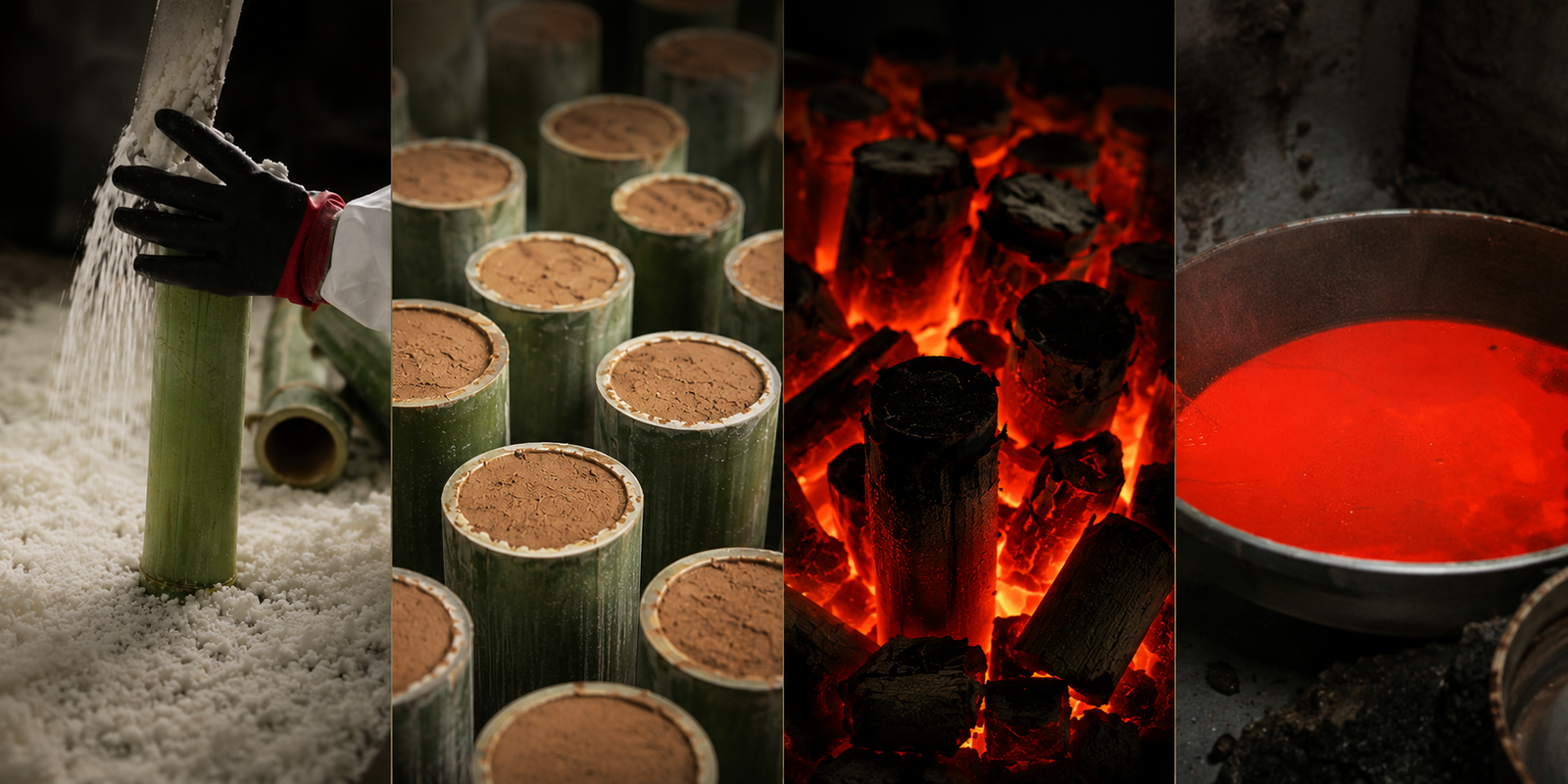
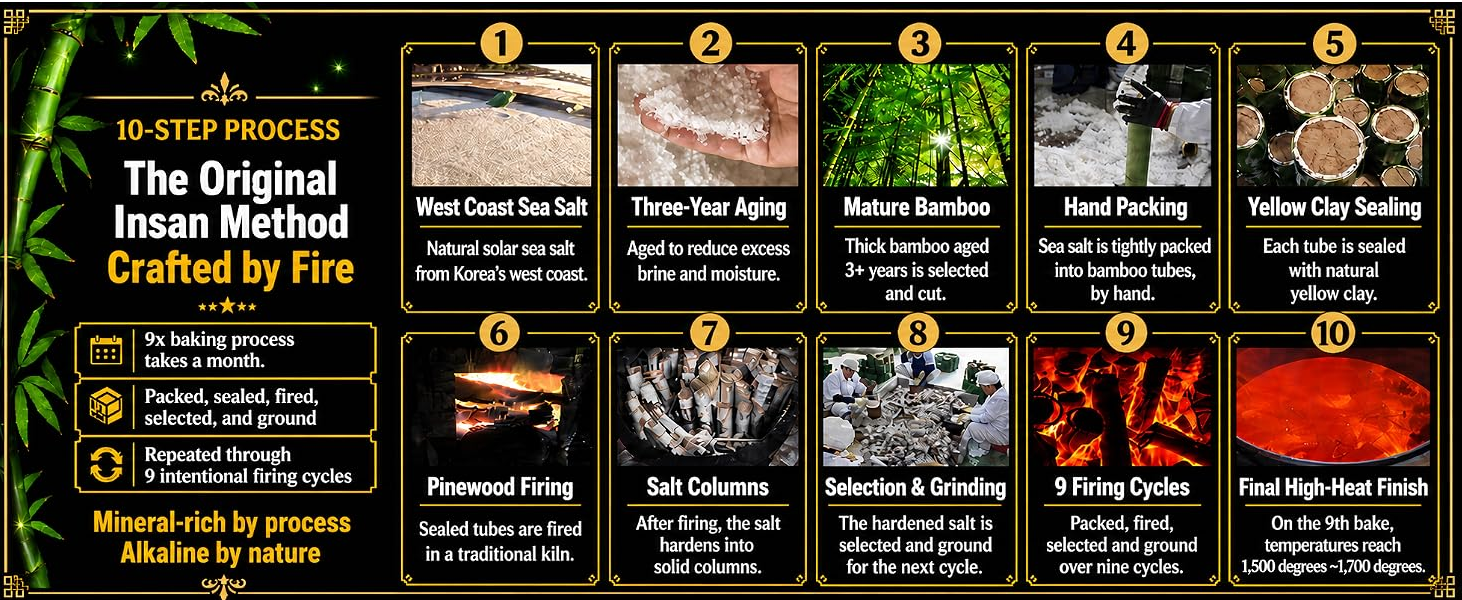
Traditional bamboo salt is made by placing sea salt inside sections of bamboo, sealing the openings with mineral-rich clay and roasting the filled bamboo with pine fire. Depending on the product, the process may be repeated several times.
In the best-known 9X style, the final stage involves high-temperature melting. Repeated heat changes the salt’s color, crystal structure, mineral profile, sulfur compounds, aroma and roasted character.
The result is still salt—but it carries the sensory and cultural imprint of a far more elaborate manufacturing process.
The Starting Mineral
Korean sea salt forms the base of the traditional bamboo salt process.
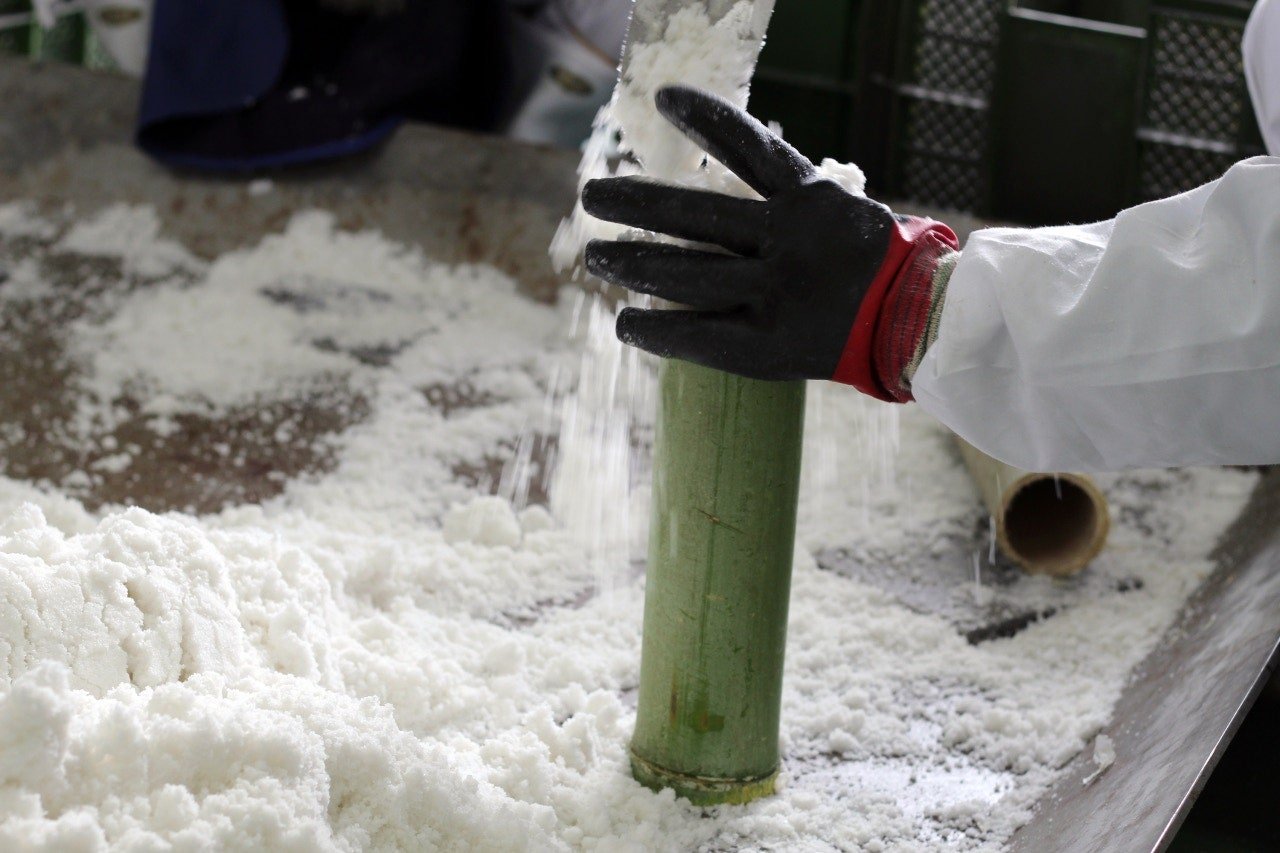
Packed by Hand
Salt is placed tightly inside bamboo sections that act as the roasting vessel.
Sealed for Roasting
The bamboo openings are sealed with clay before entering the fire.
Repeated Heat
Successive roasting stages build the product’s distinctive color, aroma and physical properties.
The 9X Identity
Premium 9X varieties complete the sequence with an intense high-temperature melting stage.
The best way to use bamboo salt is to replace ordinary salt—not to add a second layer of sodium.
Bamboo salt can be used in familiar ways: seasoning vegetables, eggs, rice dishes, soups, grilled food or simple sauces. Powder is easier to measure and dissolve, while larger crystals work well as a finishing salt or can be ground before use.
Its roasted, mineral-forward flavor may feel more pronounced than refined table salt, so begin with less, taste and adjust.
For finishing, grinding and controlled seasoning
For soups, vegetables and everyday cooking
 Korean Heritage, Modern Format
Bamboo salt has attracted scientific interest, but the evidence does not justify treating it as medicine.
Published studies have examined inflammation-related signaling, cancer-cell behavior, animal metastasis models, gastric acid secretion and physicochemical changes created during roasting.
Much of this evidence comes from laboratory cells or animals. One older gastric-ulcer study also reported no significant anti-ulcer effect, an important reminder that traditional use and laboratory interest do not automatically equal proven clinical benefit.
Anti-Inflammatory Activity
Purple bamboo salt reduced several inflammatory cytokine signals in stimulated HMC-1 cells. This was an in-vitro experiment, not a human clinical trial.
HCT-116 and Metastasis Research
Researchers studied colon-cancer cells in vitro and an animal metastasis model. The findings do not demonstrate that dietary bamboo salt treats cancer.
No Significant Anti-Ulcer Effect
A 28-day study found no statistically significant effect on gastric-acid secretion and did not demonstrate an anti-ulcer treatment effect in the experimental model.
What Roasting Changes
Research documented changes in sulfur compounds, oxidation-reduction potential and mineral composition during manufacturing. These findings describe the product rather than clinical outcomes.
Korean wellness food needs a market story as carefully prepared as the product itself.
ECOVERSE connects brand development, editorial content, market preparation, distribution and qualified partners so Korean products can enter new markets with their heritage, documentation and commercial value intact.
Brand & Editorial Content
Product stories connecting Korean food culture, manufacturing methods and modern consumer relevance.
Export Preparation
Coordination of product information, market documentation, labeling review and country-specific entry requirements.
Retail & Distribution
Development of appropriate import, offline retail, regional distribution and commercial sales channels.
Strategic Partnerships
Structured collaboration with importers, retailers, wellness operators, institutions and regional business networks.
Exploring Korean bamboo salt for international markets?
For export preparation, regional distribution, qualified offline retail placement, buyer and importer coordination, institutional projects or strategic partnerships related to INSAN Bamboo Salt and Korean wellness products, contact K-MIRACLE.
K-MIRACLE Co., Ltd. · k-miracle@k-miracle.net
Source links for further reading
Each URL is displayed in full so it can be selected, copied and pasted directly. The button beside each source also copies the link to the clipboard.
Safety and disclosure: Bamboo salt is a salt product and remains a significant source of sodium. The studies discussed in this article include laboratory and animal research and do not establish that bamboo salt prevents, treats or cures disease in people. K-MIRACLE participates in international market-development activities related to INSAN Bamboo Salt and Korean wellness products. This article is provided for cultural, manufacturing, market and general food-information purposes and does not constitute medical advice.