
In 2026, advertising is easier to buy, content is easier to produce and products are easier to imitate. The companies that survive will not be those that speak most loudly, but those that give customers a clear reason to believe, remember and return.
By Theo Kim | Global Brand Strategy & Commerce, K-MIRACLE
A familiar complaint is heard in factories, start-ups and family businesses around the world:
“Our product is genuinely good. Why does nobody recognize its value?”
The usual answer is to spend more on advertising.
More social-media posts are published. A new logo is commissioned. Influencers are hired. The packaging is redesigned. The company attends exhibitions, distributes press releases and increases promotional discounts.
Yet sales remain unstable.
The problem may not be insufficient marketing. The problem may be that the company has not built anything precise for marketing to amplify.
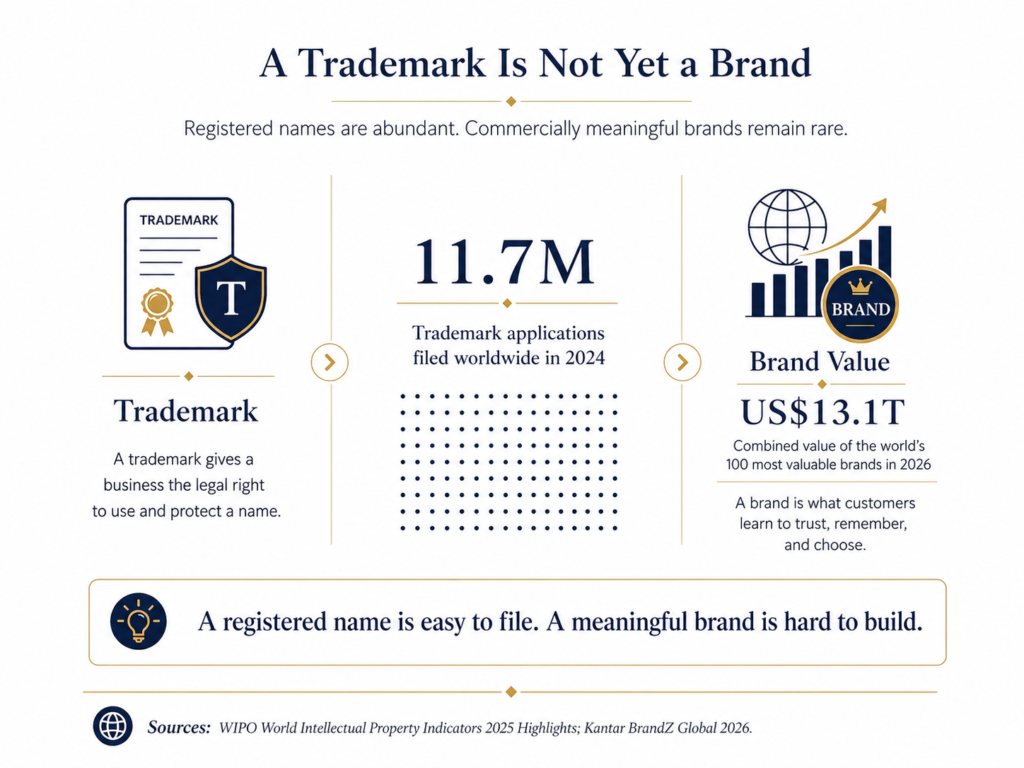
A trademark gives a business the legal right to use and protect a name. It does not tell customers what that name should mean. In 2024, approximately 11.7 million trademark applications were filed worldwide. By contrast, Kantar estimates that the world’s 100 most valuable brands together were worth US$13.1 trillion in 2026. Registered names are abundant; commercially meaningful names remain rare.
The difference is simple:
A product is what the company makes.
A brand is what the customer has learned to expect.
Why a Good Product Still Fails to Become a Brand
When manufacturers say, “Our quality is better,” they are usually describing an internal fact.
Customers cannot see internal facts.
They see packaging, price, reviews, product claims, delivery, customer service, retail presentation and the behavior of the company when something goes wrong.
A superior product can therefore lose to an ordinary one for five reasons:
- Its superiority is difficult to understand.
- Its claims are not supported by visible evidence.
- Its message changes from one channel to another.
- Its experience does not match its advertised promise.
- The customer cannot remember why it is different.
This is where many businesses make their first mistake.
They begin by asking:
“How should we promote the product?”
They should first ask:
“What should customers confidently expect when they see our name?”
That expectation must be more specific than “quality,” “innovation,” “premium” or “customer satisfaction.” Every competitor can make those claims.
A real brand expectation predicts an experience.
It may mean the safest solution in a specialist category, uncompromising material integrity, exceptionally thoughtful service, freedom from an outdated industry practice or a recognizable interpretation of beauty, performance or status.
Until that expectation is clear, advertising merely distributes ambiguity.
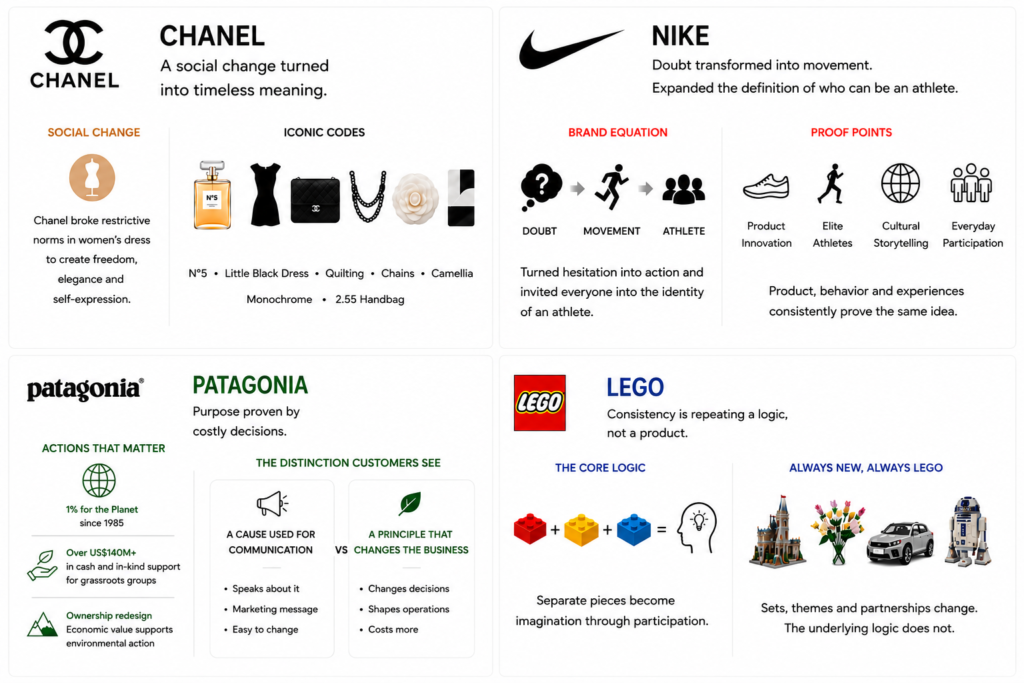
Chanel: The Product Became Powerful Because It Represented a Social Change
Chanel did not become Chanel simply because Gabrielle Chanel designed attractive clothes.
The house challenged the restrictive conventions surrounding women’s dress. Jersey, simpler silhouettes and clothing that allowed freer physical movement expressed more than a design preference. They represented a different relationship between women, elegance and personal freedom.
Chanel was not merely selling garments.
It was giving form to liberated elegance.
Over time, that central meaning was reinforced through recognizable products and codes: Chanel N°5, the little black dress, quilting, chains, camellias, monochrome contrasts and the 2.55 handbag.
The products changed. The underlying interpretation remained coherent.
That coherence still has financial force. Chanel reported US$19.3 billion in revenue and US$4.71 billion in operating profit for 2025. It also invested approximately US$2.4 billion in brand activities, including client engagement.
The lesson for an emerging business is not to imitate Chanel’s appearance.
It is to understand what Chanel actually did:
It connected a product to a change customers wanted to experience in themselves.
A skincare company does not ultimately sell cream. It may sell confidence in aging.
A food manufacturer does not merely sell ingredients. It may restore confidence in how food is made.
A space-planning business does not simply arrange furniture. It may give customers control, calm and dignity in their environment.
The product is the instrument. The human change is the meaning.

Nike: It Expanded the Definition of Who Could Be an Athlete
Nike’s greatest achievement was not inventing athletic shoes.
It created a language through which ordinary people could see themselves as athletes.
“Just Do It,” introduced in 1988, did not explain cushioning technology or shoe construction. It addressed the moment between hesitation and action.
Nike’s deeper brand equation became:
Doubt transformed into movement.
Elite athletes, product innovation, cultural storytelling and everyday participation reinforced the same idea. Nike did not say that sport belonged only to champions. It invited almost everyone into the identity of an athlete.
That is how a slogan becomes more than a slogan: the product, company behavior and customer experience continually prove it.
But Nike also offers a warning for 2026.
The company remains one of the world’s most recognized brands, yet its fiscal 2026 revenue was US$46.4 billion—flat on a reported basis and down 2% on a currency-neutral basis. Nike Brand sales declined in Greater China and EMEA, while Nike Direct revenue fell 6%.
This does not mean Nike has lost its brand.
It means that even an iconic story cannot operate independently of current products, channels and customer relevance.
A famous brand must continue earning the right to tell its famous story.
Past recognition can attract attention. It cannot permanently compensate for weakened product excitement, channel imbalance or cultural distance.
Patagonia: Purpose Became Credible Because It Became Expensive
Many companies publish social-purpose statements.
Patagonia made its environmental position influence where money went and how ownership was structured.
Since 1985, the company has pledged 1% of sales to environmental preservation and restoration and reports more than US$140 million in cash and in-kind support for grassroots environmental groups. Its ownership structure was later redesigned so that economic value generated by the company could support environmental action.
Patagonia’s lesson is not that every company must adopt an environmental mission.
The lesson is that a belief becomes a brand asset only when the company is willing to make costly decisions because of it.
Customers increasingly distinguish between:
- A cause used for communication
- A principle that changes the business
A sustainability claim that does not influence materials, packaging, sourcing, distribution or measurement is not a brand position.
It is promotional language.
The test of a declared value is not whether it appears on the website.
It is whether leadership is willing to reject revenue, absorb cost or change operations to protect it.
LEGO: A Strong Brand Does Not Repeat Products—It Repeats a Logic
LEGO demonstrates how a brand can remain recognizable while continuously creating something new.
The individual sets, themes and partnerships change. The underlying logic does not:
Separate pieces become imagination through participation.
LEGO does not simply provide a finished object. It gives customers a system through which they create.
In 2025, LEGO’s revenue rose 12% to DKK 83.5 billion, while consumer sales grew 16%. The company grew more than twice as fast as the broader toy market, even though approximately half of its product portfolio was new compared with the previous year.
This is what many companies misunderstand about consistency.
Consistency does not mean selling the same product forever.
It means that new products continue to strengthen the same central meaning.
Weak brands repeatedly change their identity to look current.
Strong brands preserve their identity and make its expression current.
The First Strategic Question: What Change Does the Customer Buy?
Most companies begin brand development by describing themselves:
- We are innovative.
- We use high-quality materials.
- We have extensive manufacturing experience.
- We provide excellent service.
These statements may be true, but they are company-centred.
Customers do not primarily buy a company’s description of itself. They buy a change in their own situation.
A stronger starting point is:
What becomes better, easier, safer, more respected or more meaningful after the customer chooses us?
Nike turns hesitation into action.
Chanel turned restriction into freedom of movement and expression.
LEGO turns parts into creative possibility.
Patagonia turns a purchase into participation in a wider environmental commitment.
An emerging brand must identify its own change.
Without it, the business remains a collection of product features.
With it, different products can begin to belong to the same story.
The Second Question: What Is Wrong with the Current Category?
Important brands frequently begin by challenging something customers have been forced to accept.
The strongest positioning may therefore be found not by asking what competitors claim, but by asking:
“What does this industry repeatedly do that customers should no longer have to tolerate?”
Perhaps the category is confusing when it should be transparent.
Perhaps premium prices are unsupported by premium service.
Perhaps traditional products are effective but presented in a form that younger customers cannot understand.
Perhaps customers must choose between attractive design and practical performance.
Perhaps the industry sells sustainability without evidence.
This is the category contradiction.
A brand gains strategic power when it resolves a contradiction that competitors have normalized.
That creates a reason to exist—not merely another reason to advertise.
The Third Question: Where Is the Proof?
A brand promise without evidence is only an intention.
If a company claims exceptional quality, where can the customer see it?
- In the materials?
- In documented performance?
- In manufacturing controls?
- In warranties?
- In repeat purchases?
- In expert endorsements?
- In how complaints are resolved?
- In the retailers and partners selected by the company?
This matters because trust is now economically central. Edelman’s 2026 research found that 88% of respondents considered trust in a brand important or critical to purchase, almost identical to quality at 89% and value for money at 88%.
Customers are not choosing between product quality and brand trust.
Trust is how they decide whether the claimed quality is believable.
The company therefore needs a proof system, not simply a promotional message.
Every major claim should be connected to evidence that can be experienced, measured or independently checked.

Stop Promoting Everything: Build One Flagship Proof
Many emerging brands launch too many products before becoming known for one thing.
The manufacturer sees variety. The customer sees confusion.
A flagship product is not necessarily the product with the highest current sales. It is the clearest demonstration of what the company deserves to be known for.
It should answer three questions quickly:
- What is this company unusually good at?
- Why should I believe it?
- Why is this difficult for others to reproduce?
Hermès has repeatedly used iconic products and craftsmanship to make its broader standards visible. Chanel has N°5 and the 2.55. Nike has product franchises and athlete stories that translate its larger promise into tangible evidence. LEGO has the brick system.
Smaller companies often attempt to promote the entire factory.
A smarter strategy is to use one product to explain the factory.
The market rarely remembers a catalogue first. It remembers a clear point of entry.
Decide What the Brand Will Refuse
Brand strategy is not only a list of activities the company plans to undertake.
It is also a set of decisions the company will refuse.
A serious brand must define:
- Products that do not belong in its portfolio
- Claims it cannot responsibly make
- Discounts that would damage its position
- Channels that weaken its credibility
- Distributors that cannot represent its standards
- Collaborations that attract attention but create confusion
- Quality compromises it will not accept
This may appear restrictive. It is actually how meaning is protected.
Every new product and sales opportunity teaches customers something about the company.
If those lessons contradict one another, the name gradually loses its ability to mean anything.
Luxury brands understand this particularly well. Controlled distribution, price discipline and selective partnerships are not simply methods of creating scarcity. They protect the context in which the brand is interpreted.
A brand becomes clearer through repetition.
It becomes valuable through boundaries.
Why Advertising Often Makes the Problem Worse
Marketing does not automatically create a brand.
It accelerates the market’s discovery of whatever the business already is.
When the product, identity and experience are coherent, advertising accelerates recognition and trust.
When they are inconsistent, advertising accelerates confusion.
When service is poor, it brings more customers into contact with poor service.
When claims exceed performance, it increases disappointment.
This creates brand debt: the accumulated gap between what the company says and what customers experience.
The business then spends more money replacing disappointed customers, overcoming weak reviews, defending prices and explaining why it should still be trusted.
Before increasing advertising expenditure, management should conduct a simple test:
If ten recent customers were asked what this company stands for, would their answers be broadly similar?
When every answer is different, the problem is not reach.
It is meaning.
Branding in 2026 Must Persuade Both People and Machines
The competitive environment is becoming more difficult because customers are no longer discovering products only through shops, advertisements and conventional search engines.
Shopping-related searches on generative-AI platforms increased 4,700% between 2024 and 2025. McKinsey reported that 41% of consumers trusted generative-AI search results more than traditional paid advertising, while 85% of consumers using AI for shopping reported a better experience than with traditional methods.
McKinsey also projects that US$750 billion in US revenue could flow through AI-powered search by 2028.
This changes the meaning of visibility.
In the past, a company could purchase advertisements and place itself in front of customers.
Increasingly, an AI system may first compare the company’s products, reviews, claims, prices, documentation and reputation—and decide whether to recommend it at all.
The future brand must therefore communicate in two languages.
Human meaning
Emotion, identity, aspiration, belonging, design and cultural relevance.
Verifiable evidence
Consistent product information, documented claims, certifications, expert content, customer outcomes, policies and independent references.
A brand with emotional appeal but weak evidence may not survive serious comparison.
A brand with excellent evidence but no human meaning may be considered but easily replaced.
The winners will unite both.
Where a Business Should Begin
Brand development should not begin with another logo or slogan.
It should begin in this order:
1. Define the customer change
Complete this sentence:
“After choosing us, the customer can now ______.”
2. Identify the category contradiction
Determine what customers currently tolerate that the business can credibly improve.
3. Select one flagship proof
Use the clearest product or service to demonstrate the company’s central authority.
4. Align operations with the promise
Make product quality, service, pricing, packaging, guarantees and distribution prove the same idea.
5. Build recognizable codes
Create a limited visual, verbal and experiential system—and stop replacing it before customers learn it.
6. Organize the evidence
Ensure that the website, marketplaces, media articles, distributors, documents and customer reviews describe the product consistently.
7. Establish refusal rules
Decide which revenue opportunities the company will reject to preserve long-term meaning.
Only after these steps should the company significantly expand advertising.
Otherwise, it is paying to make an unresolved business more visible.
The Coldest but Most Useful Test
The most important brand metric is not follower count or advertising impressions.
It is:
What remains when promotion stops?
Do customers still search for the company by name?
Do they purchase again?
Do they recommend it?
Will they pay the normal price?
Can they explain why it is different?
Does trust in one product help the company introduce another?
If demand disappears as soon as paid promotion stops, the company may have built traffic rather than a brand.
A brand begins to exist when previous evidence reduces the cost of earning the next decision.
Each successful experience makes the name more useful. Each consistent product makes the next product easier to trust. Each well-resolved problem becomes evidence of character.
That is how trust compounds.
The Essential Conclusion
A trademark protects a name.
A product creates a transaction.
Advertising creates exposure.
But a brand is created only when a company repeatedly turns one clear meaning into believable evidence.
The first question is therefore not:
“How can we make more people know our brand?”
It is:
“What should people know us for—and have we built a business capable of proving it?”
The strongest brands did not become global because they talked about everything.
They selected a meaning, built proof around it, made it recognizable and protected it from short-term contradictions.
Do not begin with more content. Begin with clearer meaning.
Do not promote the entire catalogue. Build one unmistakable proof.
Do not copy the appearance of famous brands. Study the discipline that made their names meaningful.
A good product may deserve attention.
A real brand gives customers a reason to trust it before the company has to explain itself again.
K-MIRACLE ECO VERSE
K-MIRACLE ECO VERSE helps manufacturers and emerging businesses define what their brands should represent, turn that meaning into credible product and operational evidence, and connect it with media, market education, distribution and global expansion. Its purpose is not to make small companies imitate famous brands, but to help them build the clarity, proof and consistency through which genuine brands become known and trusted.
The views expressed in this article are those of the author. Research figures reflect the methodologies and reporting periods of the cited organizations.