

The greatest risk in Asian expansion is not insufficient localization. It is entering a market while allowing a distributor, platform or importer to own everything the manufacturer needs to learn from it.
By Theo Kim | Global Brand Strategy & Commerce, K-MIRACLE : ECOVERSE
The standard advice for entering Asia is familiar: research each country, localize the product, appoint a distributor and begin with a pilot.
None of this is wrong. It is simply incomplete.
A more important question is rarely asked:
After entering the market, who owns the knowledge generated by it—the manufacturer or the intermediary?
A company can complete product registration, ship inventory and generate sales while learning almost nothing about the market itself.
The distributor knows which customers are buying. The platform holds search and conversion data. The retailer controls the final price. The agency manages advertising accounts. The importer may even control regulatory registrations.
The manufacturer receives a purchase order and a monthly sales total.
Operationally, it has entered the market. Strategically, it remains outside it.
Large Markets Are Not Automatically Accessible Markets
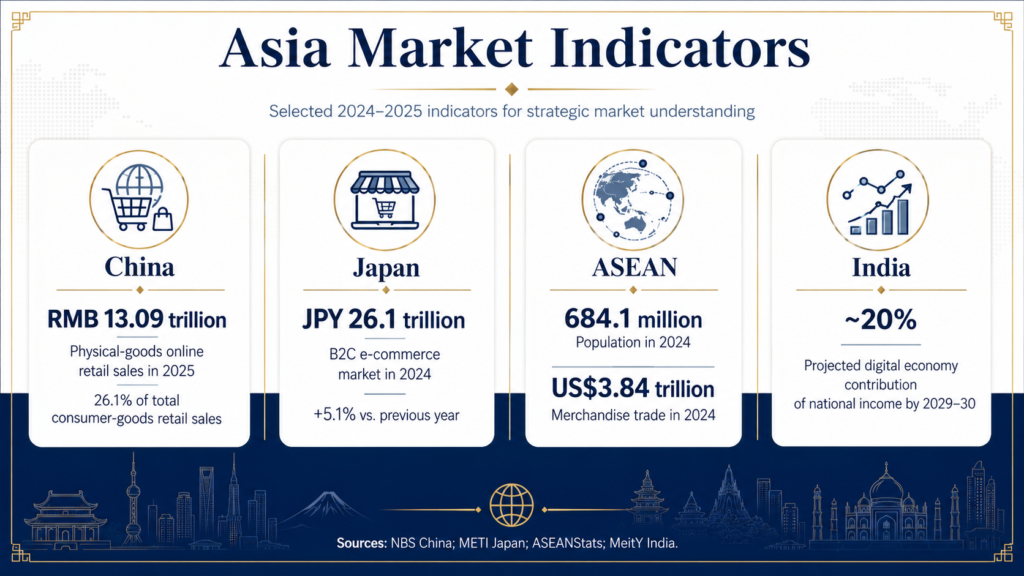
Asia’s headline numbers are undeniably attractive.
China’s physical-goods online retail sales reached RMB 13.09 trillion in 2025, accounting for 26.1% of total consumer-goods retail sales. Japan’s B2C e-commerce market reached JPY 26.1 trillion in 2024, growing 5.1% from the previous year. ASEAN recorded a population of 684.1 million and merchandise trade of approximately US$3.84 trillion in 2024. India projects that its digital economy could contribute nearly one-fifth of national income by 2029–30.
But these figures do not describe one integrated consumer market.
China’s scale may depend on platform visibility, local content and rapid digital demand generation. Japan may place greater weight on consistency, documentation and trusted distribution. ASEAN contains national markets with sharply different languages, income levels, regulations and retail structures. India’s digital growth still requires city-, state- and segment-level execution.
Market size indicates how much opportunity may exist. It does not indicate how much of that opportunity a particular manufacturer can realistically reach, understand and retain.
The Real Unit of Expansion Is a Learning System
Manufacturers usually compare markets through population, GDP, growth rates and e-commerce penetration.
Those indicators measure potential. They do not measure whether the company can learn from the market.
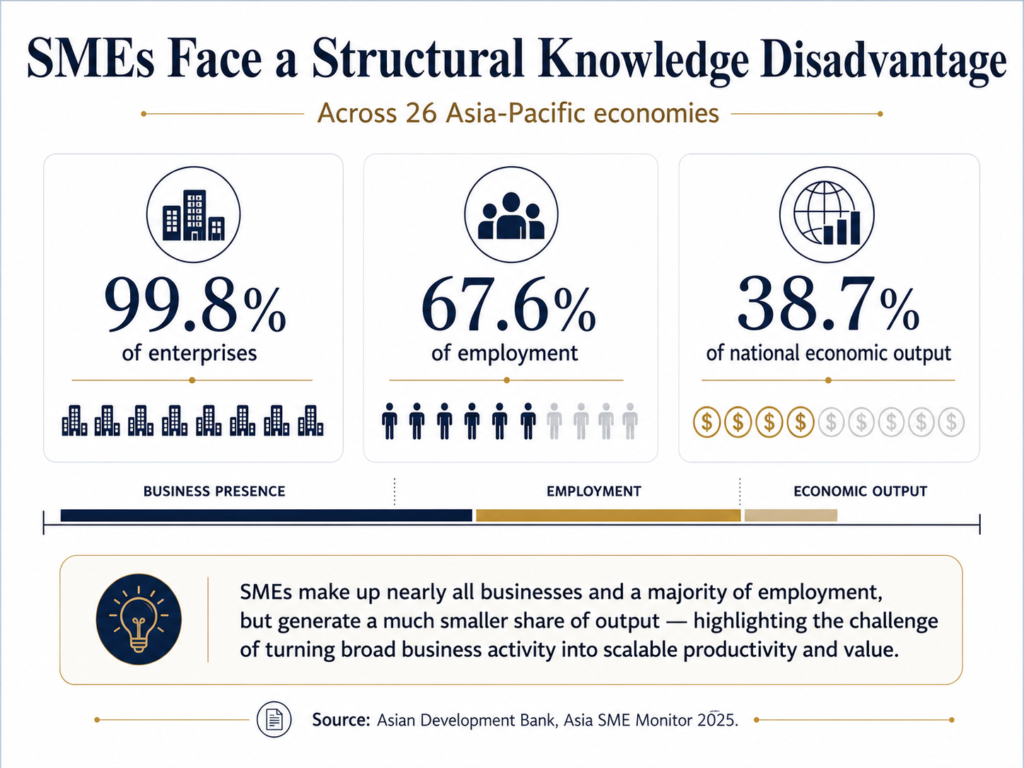
This distinction matters because smaller companies already face a structural knowledge disadvantage. Across 26 Asia-Pacific economies, micro, small and medium-sized enterprises represented an average of 99.8% of enterprises and 67.6% of employment, but only 38.7% of national economic output, according to the Asian Development Bank’s 2025 SME Monitor. This gap is not caused by market knowledge alone, but it illustrates the challenge of converting widespread business activity into scalable productivity and value.
The OECD also notes that SMEs face particular difficulties in finding and managing the technology, data and networks needed for innovation and growth. Earlier OECD–APEC research identified insufficient knowledge of overseas markets and a lack of international contacts as leading internal barriers to SME internationalization. The terminology has changed, but the underlying information gap remains.
A useful market pilot must therefore answer more than:
“Did the product sell?”
It should reveal why customers purchased, why others declined, which message created trust, how much demand depended on discounts, whether customers bought again and what caused returns.
Sales without these answers may produce revenue while increasing dependence on whoever controls the information.
Manufacturers Must Learn the Market—Even When a Distributor Operates It
This does not mean manufacturers should replace local distributors or attempt to manage every foreign-market function directly.
A good distributor brings capabilities that an overseas manufacturer often lacks: regulatory knowledge, buyer relationships, local logistics, retail access, language, after-sales service and commercial credibility.
The problem begins when the manufacturer outsources not only execution, but also judgment.
Manufacturers must develop enough market literacy to evaluate what their partners are doing. At minimum, they should understand:
Customer logic: Who actually buys the product, what problem are they solving, and what evidence creates trust?
Channel economics: How do importer, distributor, retailer, platform and promotional margins affect the final consumer price?
Regulatory ownership: Who owns registrations, approvals, local product files and responsible-party relationships?
Data interpretation: Which metrics distinguish real demand from inventory loading, discount-driven sales or one-time promotions?
Partner governance: What should the distributor report, what must remain transferable, and what performance justifies exclusivity?
A manufacturer does not need to know the market better than its distributor on day one.
It must know enough to ask the questions that prevent the distributor from becoming the only party capable of explaining the business.
The Distributor’s Role Should Extend Beyond Buying Inventory
A distributor should not be treated merely as a customer placing wholesale orders.
Its proper role is closer to that of a local market operator and intelligence partner.
A capable distributor should:
- Navigate importation and compliance requirements
- Build access to relevant retail and professional channels
- Establish a commercially viable local price structure
- Create demand rather than simply wait for orders
- Report sell-through, inventory and promotional performance
- Gather customer, retailer and competitor intelligence
- Transfer enough learning for joint strategic decisions
This distinction is critical because sell-in is not sell-through.
A large initial order shows that a distributor accepted inventory. It does not prove that customers accepted the product.
Manufacturers should therefore evaluate partners using downstream evidence: active retail accounts, SKU-level sell-through, repeat orders, inventory aging, return reasons, campaign conversion and customer feedback.
The distributor should operate the market. It should not become the sole owner of the market’s memory.
The Hidden Risk Is Channel Compression
When one partner controls importation, regulatory approval, inventory, marketplace accounts, marketing and customer relationships, market entry becomes convenient.
It also becomes difficult to reverse.
This is channel compression risk: the manufacturer reduces short-term complexity by concentrating multiple functions in one intermediary, but creates long-term dependency and higher switching costs.
The OECD recognizes that online platforms can give SMEs market access, analytics, logistics and customer trust. It also warns of lock-in, competition risks and “winner-takes-most” dynamics arising from powerful network effects.
The same mechanism can appear in distributor relationships. In a sector-specific study involving samples of 105 and 444 participants, researchers found that power imbalance was associated with increased opportunism and reduced financial performance for the weaker party; dependency, limited alternatives and high switching costs intensified the problem. The study concerned an agri-food supply chain, so its results should not be generalized mechanically to every industry, but the dependency mechanism is directly relevant to international distribution.
The most dangerous condition may therefore not be formal exclusivity.
It may be data silence combined with high switching costs.

Exclusivity Is the Transfer of a Future Option
Territorial exclusivity is frequently granted in return for a promising first order.
That is a weak basis for a long-term decision.
Exclusivity does not merely give a distributor permission to sell. It can prevent the manufacturer from appointing another partner, opening a direct marketplace account, working with specialist retailers or testing a different pricing model.
The manufacturer is transferring part of its future strategic option.
Exclusivity should therefore be conditional upon continued performance, including:
- Regulatory completion within a defined period
- Minimum purchase and sell-through targets
- Agreed marketing investment
- Active-account or retail-door targets
- Regular inventory and customer reporting
- Defined geographic and channel coverage
- Automatic reduction or termination if targets are missed
The correct question is not:
“How large is the first order?”
It is:
“What must the distributor continue to prove in exchange for limiting our alternatives?”
Market Assets Must Remain Visible and Transferable
Before market entry, manufacturers should determine who will own or control the assets created during the partnership.
Trademark rights should ordinarily remain with the brand owner. Regulatory registrations should be held by the manufacturer where legally possible, or governed by clear transfer and transition provisions. Marketplace accounts, advertising data, reviews, product content and customer insights should not disappear if the distributor relationship ends.
At minimum, the operating agreement should provide the manufacturer with:
- Monthly sell-in and sell-through data by SKU and channel
- Inventory aging and forecast information
- Promotion and advertising performance
- Pricing and discount history
- Customer complaints, returns and product feedback
- Access to marketplace and campaign analytics
- Transfer procedures for registrations, accounts and product files
- A defined transition period following termination
These are not administrative details.
They determine whether the manufacturer is building a market asset or temporarily renting access through another company.
Localization Should Begin with Trust, Not Translation
Most companies begin localization with language, packaging and advertising.
A more useful starting point is:
Where is trust stored in this market?
In one country, trust may reside in marketplace reviews. In another, it may come from a pharmacist, specialist retailer, hospital, importer, industry association or professional recommendation.
This explains why the same marketing strategy can produce very different results across Asian markets.
A manufacturer may spend heavily on advertising while customers are waiting for retail endorsement. It may produce elegant localized content while regulatory documentation is the real credibility threshold. It may appoint a prestigious distributor even though purchase decisions are driven mainly by user reviews and price comparisons.
The first localization task is therefore not translation.
It is identifying the institution, platform or relationship through which the market decides what is credible.
The Best First Market Is Where Mistakes Are Reversible
Manufacturers often select the largest market first.
A better first market may be the one where the company can learn quickly without becoming trapped by its earliest assumptions.
Before entry, decision-makers should ask:
Can the distributor be replaced without losing product registration? Can inventory be redirected? Can the marketplace account and reviews remain with the brand? Can prices be adjusted without permanently damaging positioning? Can the company preserve customer insights if the partnership ends?
A smaller market with transparent data and reversible commitments may create greater strategic value than a larger market requiring heavy investment and long-term dependency.
The purpose of the first market is not to generate the most impressive announcement.
It is to improve the quality of the next decision.

Key Takeaways
Market access is not market understanding. Registration, shipment and an initial purchase order do not prove that a manufacturer understands customer demand.
The distributor should operate the market, not monopolize its knowledge. Execution can be delegated; strategic learning cannot.
Manufacturers must build market literacy. They should understand customer behavior, channel economics, regulatory ownership, data and partner governance.
Exclusivity must be earned continuously. It should be connected to measurable performance, reporting and automatic release provisions.
Choose a market where errors can be corrected. Reversibility, data access and transferable assets may be more valuable than headline market size.
A brand has established a genuine strategic foothold only when it can explain—without relying entirely on an intermediary—why customers buy, why they do not, which channels create value, which price produces sustainable economics and what should change next.
Use distributors, but do not outsource intelligence.
Generate sales, but retain the ability to change direction.
Enter one country, but preserve what that country teaches you.
Asia is not one market.
More importantly, a purchase order is not yet market knowledge—and market presence is not yet market control.
This perspective reflects ECO VERSE’s broader role in connecting brand visibility, market preparation and strategic product-to-market pathways, rather than treating overseas expansion as a single promotional or distribution transaction.
The views expressed in this article are those of the author. Regulatory, tax, distribution and product-entry requirements should be independently verified for each jurisdiction and product category.