
By K-MULBIT NEWS & HUB NEWS | Environmental Desk
April 29, 2026 | Opinion / Environment
Introduction
We live by discarding. Yet nothing we throw away truly disappears. Instead, it re-emerges—reshaped and redistributed—across oceans, cities, and ecosystems. What was once considered an abstract environmental concern has become a visible, measurable condition embedded in everyday life.
According to the United Nations Environment Programme, millions of tons of plastic waste enter marine ecosystems annually, underscoring the scale and persistence of global waste streams.
Art as Environmental Interface
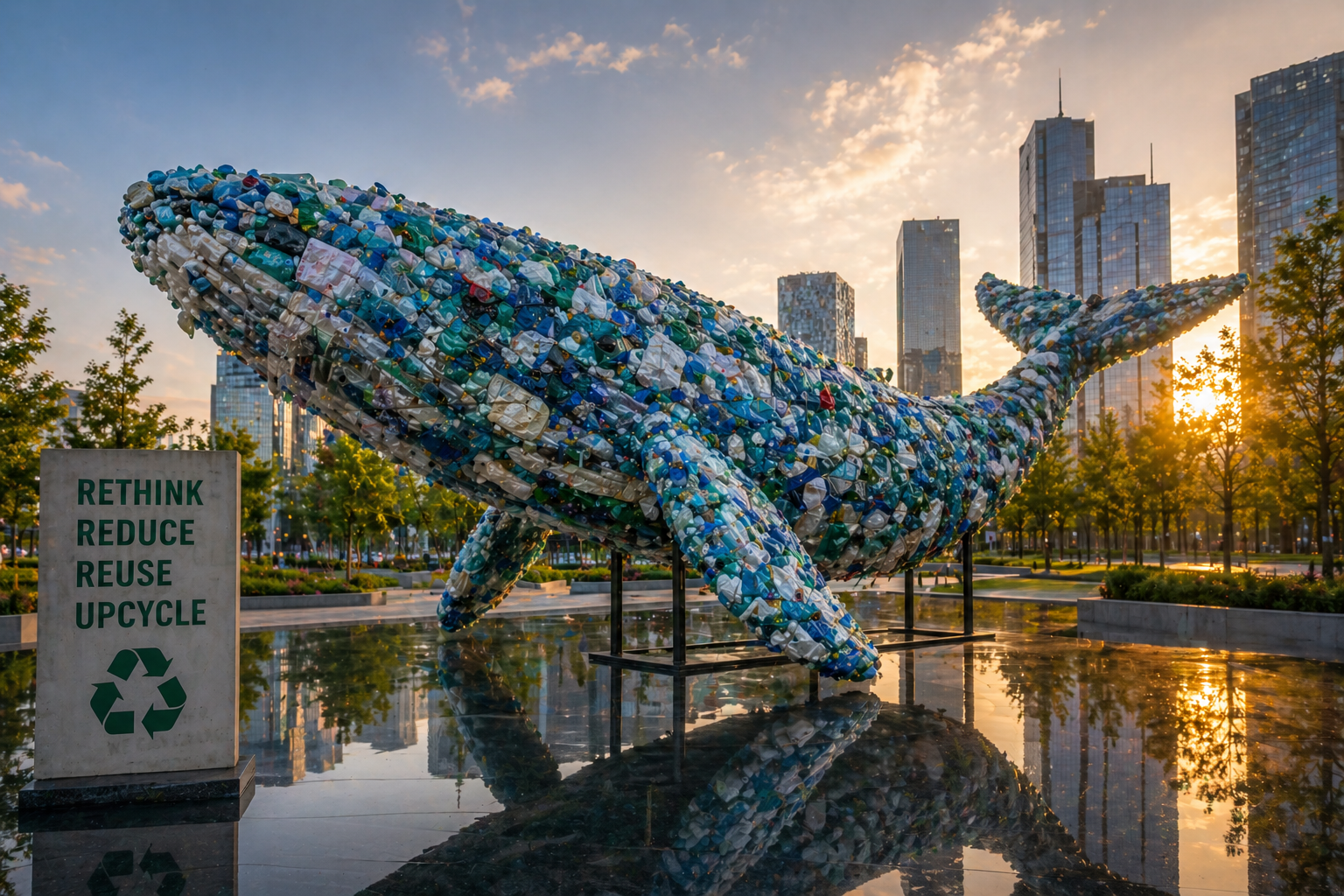
In response, contemporary art is evolving beyond aesthetics into a form of environmental interface. Increasingly, artists are working directly with discarded materials, transforming waste into visual narratives that reflect patterns of consumption.
Upcycling art differs from traditional recycling in that it preserves the identity of materials. Objects are not reduced to raw inputs but remain recognizable—allowing audiences to confront their origin and lifecycle.
Installations using plastic debris, industrial waste, and reclaimed materials are now appearing in public environments rather than confined to galleries. This shift changes how audiences engage with environmental issues—not as distant data, but as immediate experience.
Art as Environmental Interface
In response, contemporary art is evolving beyond aesthetics into a form of environmental interface. Increasingly, artists are working directly with discarded materials, transforming waste into visual narratives that reflect patterns of consumption.
Upcycling art differs from traditional recycling in that it preserves the identity of materials. Objects are not reduced to raw inputs but remain recognizable—allowing audiences to confront their origin and lifecycle.
Installations using plastic debris, industrial waste, and reclaimed materials are now appearing in public environments rather than confined to galleries. This shift changes how audiences engage with environmental issues—not as distant data, but as immediate experience.
K-MULBIT NEWS & HUB NEWS / Environmental Desk
Case Study: Re:moon
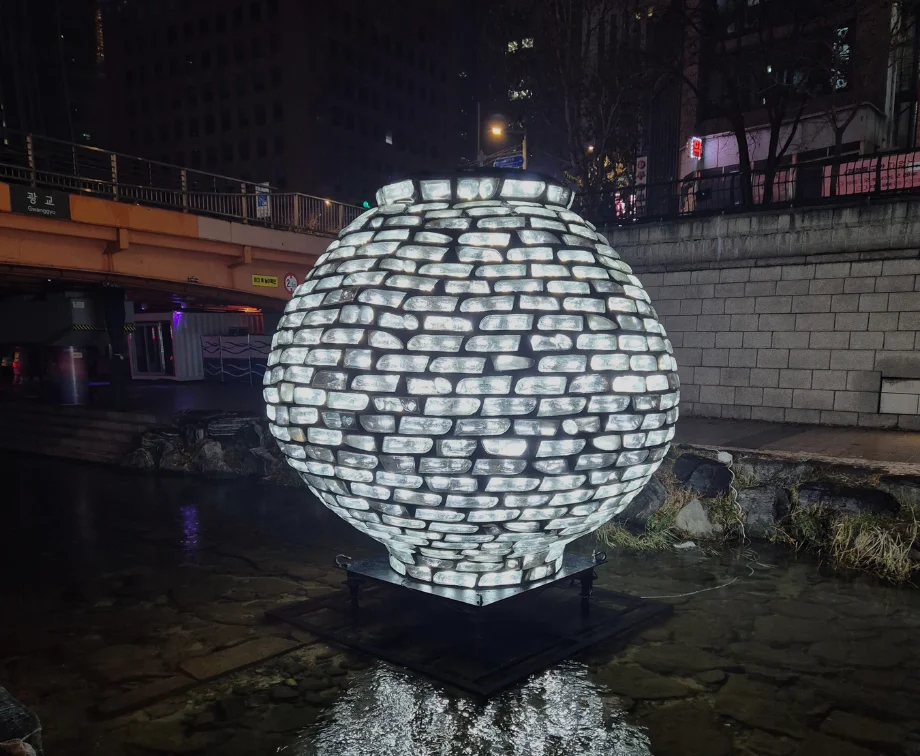
One prominent example is Re:moon by Han Won-seok, presented at the Cheonggyecheon Lantern Festival.
The installation consists of approximately 600 discarded automobile headlights arranged into the form of a traditional Korean moon jar. Once used for illumination on roads, these materials are reconfigured into a symbolic structure that emits light in a new context.
The moon jar, rooted in Korean ceramic tradition, represents balance and simplicity. By reconstructing this form using industrial waste, the work juxtaposes historical symbolism with contemporary material reality.
System-Level Context
The significance of upcycling art aligns with broader sustainability frameworks. The OECD projects that global material consumption could nearly double by 2060 without systemic intervention.
Similarly, circular economy principles promoted by the Ellen MacArthur Foundation emphasize extending material lifecycles—an idea visually embodied in upcycling practices.
Conclusion
Upcycling art does not aim to solve environmental challenges directly. Instead, it reshapes perception by making waste visible and persistent.
By transforming discarded materials into public installations and everyday objects, it disrupts the invisibility of waste systems and reframes consumption as a continuous cycle rather than a linear process.
In doing so, it raises a fundamental question: what happens to what we discard?