From K-beauty exports to digital health, functional foods and green finance standards, Korea is building a new model of sustainable life-care industry.
By K-MULBIT Global Media & Hub
Category: Global ESG News
South Korea – South Korea’s wellness industry is no longer a narrow consumer trend. It is rapidly becoming a strategic national industry shaped by demographic pressure, digital transformation, export competitiveness and ESG-driven policy infrastructure.
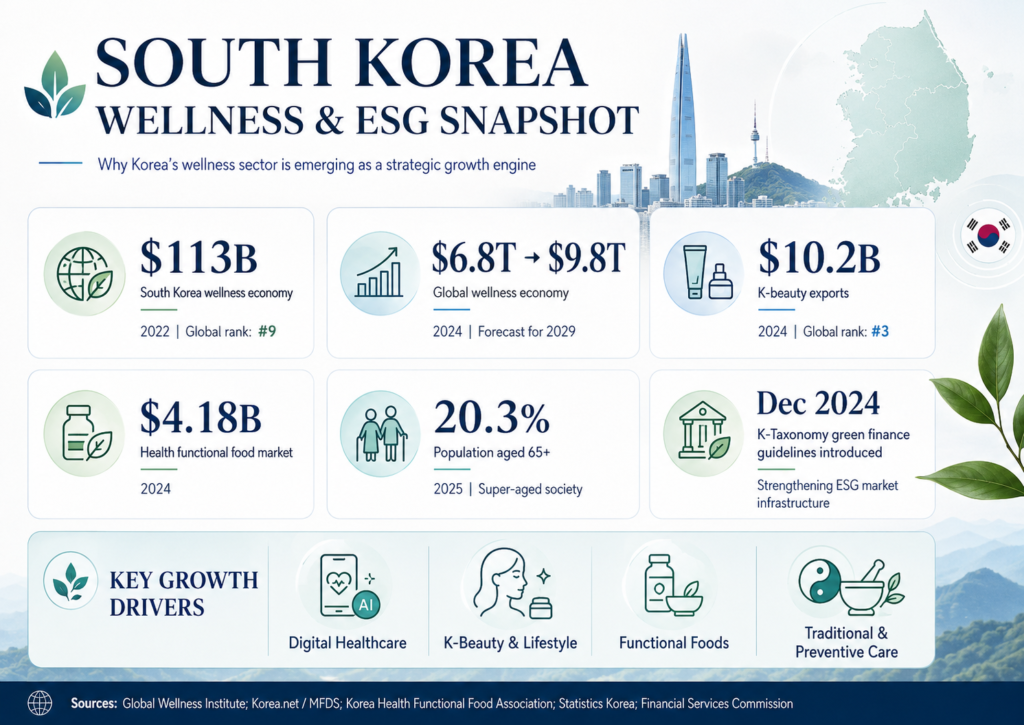
The timing is significant. The global wellness economy reached a record $6.8 trillion in 2024 and is projected to expand to nearly $9.8 trillion by 2029, according to the Global Wellness Institute. Wellness now represents more than a lifestyle category; it is emerging as one of the world’s most influential economic sectors, growing faster than global GDP.
For South Korea, this global shift is not theoretical. The country already holds a strong position in the wellness economy. GWI identified South Korea as the world’s ninth-largest wellness market, valued at $113 billion in 2022, up from $99.6 billion in 2019 after recovering from the pandemic downturn. The country also ranked sixth globally in both physical activity and traditional and complementary medicine, and eighth in public health, prevention and personalized medicine, as well as workplace wellness.
These numbers suggest that Korea’s wellness sector is not only growing, but also becoming structurally aligned with the ESG agenda: healthier lives, responsible consumption, digital care, sustainable urban lifestyles and transparent governance.
Korea’s Wellness Strength Is Built on More Than K-Beauty
K-beauty remains one of Korea’s most visible global success stories. In 2024, South Korea’s cosmetics exports reached a record $10.2 billion, according to the Ministry of Food and Drug Safety data reported by Korea.net. The momentum has continued: Korean beauty product exports rose 19% year-on-year to a record $3.1 billion in the first quarter of 2026, according to Yonhap, citing government data.
However, Korea’s wellness competitiveness is broader than cosmetics. It includes functional foods, preventive health, digital healthcare, traditional Korean medicine, mental wellness, wellness tourism and lifestyle-based care services.
In the health functional food sector, Korea’s market reached approximately $4.18 billion in 2024, according to the Korea Health Functional Food Association, based on MFDS data. The same report found that 83.2% of Korean consumers had experience purchasing health functional foods in 2024, showing that preventive wellness has become deeply embedded in everyday consumer behavior.
This matters because the future of wellness is not only about products. It is about systems. Korea’s advantage lies in its ability to connect consumer trust, health-oriented routines, advanced manufacturing, regulated product standards, digital platforms and export channels into one integrated industry structure.
A Super-Aged Society Is Turning Wellness Into Infrastructure
Korea’s rise as a wellness economy is also being shaped by one of its most urgent social challenges: population aging.
In 2025, South Korea’s population aged 65 and older surpassed 20% for the first time, officially placing the country in the category of a super-aged society. Statistics Korea data cited by Xinhua showed that the number of Koreans aged 65 or older reached 10.51 million, accounting for 20.3% of the total population.
This demographic transition is creating a new policy and market reality. Wellness can no longer be treated as optional consumption. It is increasingly connected to preventive care, chronic disease management, home-based services, social participation, mental health and community resilience.
For Korea, the wellness industry is becoming a response to national-level issues: rising medical costs, labor-force shrinkage, elderly care demand, loneliness, health inequality and regional economic revitalization.
This is where the concept of ESG Life Care becomes especially relevant. A sustainable society cannot be built only through corporate reporting. It also requires practical systems that help people live healthier, more independent and more connected lives.
Digital Healthcare Is Becoming a Core ESG Tool
Korea’s digital transformation gives the wellness sector another strategic advantage. The country has strong infrastructure in mobile technology, AI, medical devices, health data and consumer platforms. These strengths are increasingly being connected to healthcare and daily wellness management.
The regulatory environment is also evolving. During the medical workforce crisis in 2024, South Korea temporarily expanded telemedicine access across hospitals and clinics. Reuters reported that the government allowed telemedicine services more broadly as part of emergency medical measures. In December 2025, South Korea’s National Assembly approved an amendment to provide a legal basis for telemedicine, according to Chosun Biz.
This shift matters for ESG because digital healthcare can support access, prevention and efficiency. When properly governed, AI-based care, wearable devices, remote monitoring and personalized wellness services can reduce pressure on hospitals while helping individuals manage health risks earlier.
Korea’s challenge will be to ensure that this digital wellness infrastructure is not only convenient, but also ethical, secure, inclusive and internationally interoperable.
ESG Policy Is Moving From Reporting to Market Infrastructure
Korea’s wellness growth is also taking place alongside a broader ESG policy transition.
The Financial Services Commission has developed domestic ESG disclosure standards designed to be interoperable with global standards. The draft framework focuses first on mandatory climate-related disclosure, including governance, strategy, risk management, and current and target indicators.
At the same time, Korea is strengthening green finance. In December 2024, the Financial Services Commission, Ministry of Environment and Financial Supervisory Service introduced administrative guidelines for applying the Korean Green Taxonomy to financial activities. The guidelines aim to clarify green finance standards, reduce greenwashing risks and help financial institutions support environmentally aligned economic activities.
This is important for the wellness industry because the next phase of global competitiveness will not be measured only by product quality or brand popularity. It will also be measured by sustainability, traceability, responsible sourcing, transparent claims, ethical data use and social contribution.
In this sense, Korea’s ESG progress is not simply about compliance. It is creating the operating environment for future industries — including wellness — to grow with stronger credibility.
The Strategic Opportunity: Korea as an ESG Wellness Export Model
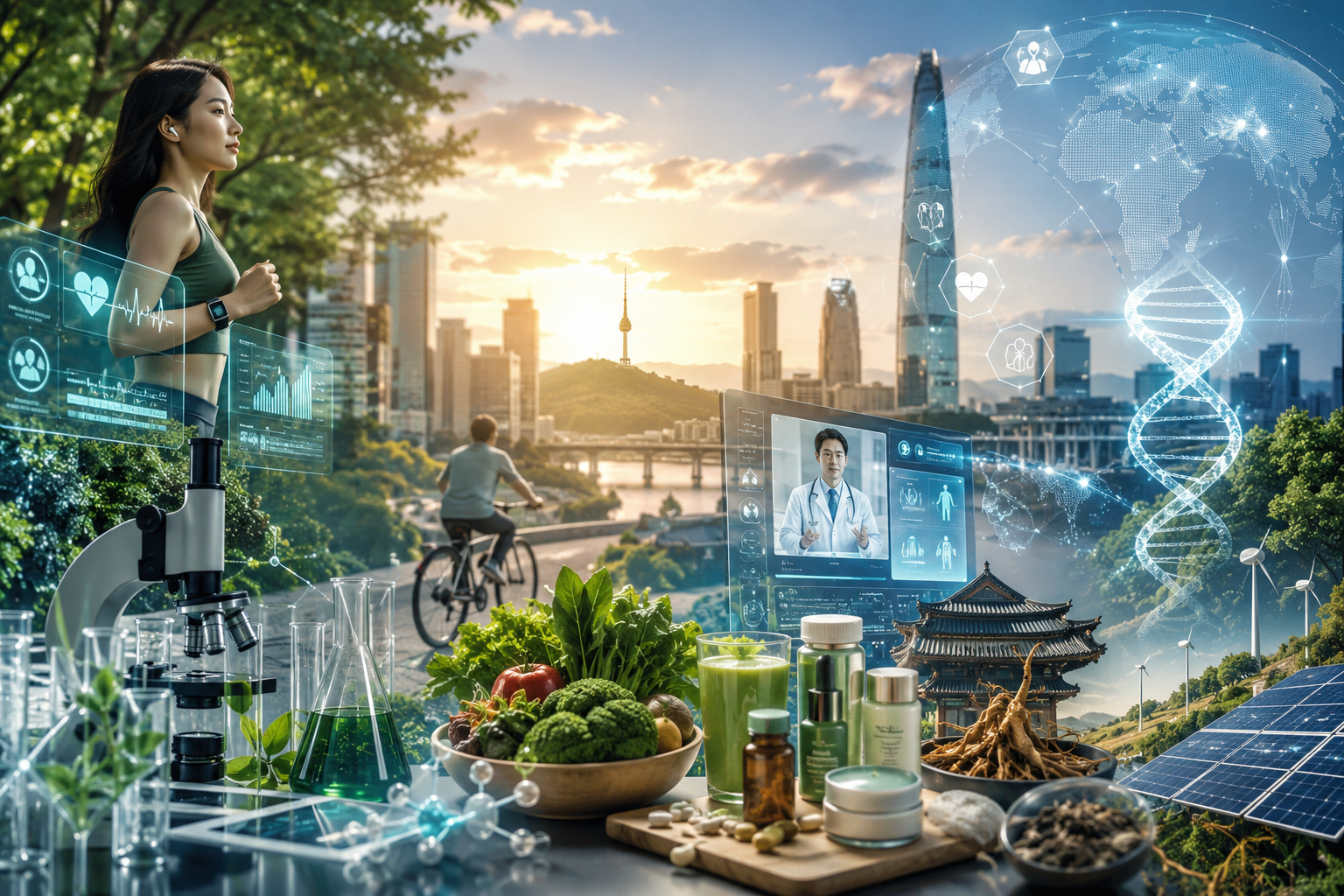
Korea’s wellness economy has several advantages that many countries are trying to build at once: global beauty influence, advanced digital infrastructure, a strong functional food market, regulated health product systems, traditional medicine assets, wellness tourism potential and growing ESG finance standards.
This combination gives Korea a unique opportunity. The country can move beyond exporting individual products and begin exporting wellness operating systems: education, certification, product standards, service models, digital platforms, care routines, tourism programs and ESG-based community business models.
The potential is especially strong across Asia, where many countries are facing similar pressures: aging populations, rising middle-class health demand, urban stress, environmental concerns and growing interest in Korean lifestyle culture.
Korea’s next wellness export may not be only a serum, supplement or tourism package. It may be a full life-care model that connects health, beauty, prevention, sustainability, local commerce and community care.
Challenges Remain
Despite strong momentum, Korea still faces important tasks.
First, digital healthcare and wellness data require stronger international standardization. Services built for domestic users must be adapted for global compliance, privacy rules and medical regulations.
Second, wellness exports must move beyond trend-based marketing. Global consumers and regulators are increasingly sensitive to exaggerated health claims, environmental claims and social impact claims. The more Korea’s wellness products expand, the more important evidence-based communication will become.
Third, sustainability must be integrated into product development. Packaging, ingredients, logistics, manufacturing emissions and community impact will increasingly shape brand credibility.
Finally, Korea must make wellness inclusive. A true ESG wellness model should not only serve premium consumers. It should also support older adults, local communities, workers, caregivers and vulnerable groups.
Conclusion: Korea’s Wellness Industry Is Becoming a New ESG Language
South Korea is entering a decisive moment. Its wellness industry is no longer just a reflection of consumer taste. It is becoming a strategic platform for economic growth, public health innovation, export expansion and ESG implementation.
The country’s strength lies in the way multiple sectors are converging: K-beauty, functional foods, traditional medicine, digital health, wellness tourism, ESG finance and sustainable lifestyle culture.
If Korea can connect these assets into transparent, measurable and globally adaptable systems, it can become more than a wellness market. It can become a global reference model for ESG-based life care.
The future of ESG will not be built only in boardrooms. It will also be built in how people live, eat, age, recover, consume, move and care for one another.
In that future, Korea has a powerful story to tell — and an industry ready to scale.
Sources & References
Global Wellness Institute — Global Wellness Economy Statistics & Facts.
Global Wellness Institute / PRNewswire-PRWeb — South Korea’s $113 billion wellness economy.
Korea.net / Ministry of Food and Drug Safety — 2024 Korean cosmetics exports.
Yonhap News — Korean beauty exports in Q1 2026.
Korea Health Functional Food Association — 2024 Korean health functional food market data.
Statistics Korea data via Xinhua — South Korea’s super-aged society statistics.
Reuters — Temporary expansion of telemedicine in South Korea.
Chosun Biz — National Assembly approval of telemedicine legal basis.
Financial Services Commission — Domestic ESG disclosure standards draft.
Financial Services Commission — Green finance guidelines and K-Taxonomy application.