

Why Sustainability Must Begin with the Choices We Make at Home
Opinion | Sustainable Living
ESG is often discussed in boardrooms, investment meetings, and corporate sustainability reports. It is usually framed as a responsibility of companies, institutions, and governments. Yet the deeper meaning of ESG — environmental responsibility, social value, and transparent practice — does not belong only to large organizations. It also belongs to ordinary people, ordinary households, and ordinary daily routines.
The next stage of ESG may not begin with a policy document or a corporate pledge. It may begin with the way we commute, the way we consume, the way we take care of our health, and the way we participate in our local communities.
This is where the concept of ESG Life Care becomes meaningful. ESG Life Care is not about turning sustainability into a distant slogan. It is about translating ESG values into practical habits that improve personal well-being, strengthen community resilience, and create a more circular economy.
In other words, it asks one simple but powerful question:
How can we raise the ESG index of our own lives?
Making the Invisible Carbon Footprint Visible
The environmental value of ESG is often the easiest to understand but the hardest to feel. We know that carbon emissions matter. We know that waste reduction matters. But in everyday life, these issues can feel too large, too abstract, or too disconnected from personal action.
That changes when small behaviors become visible.
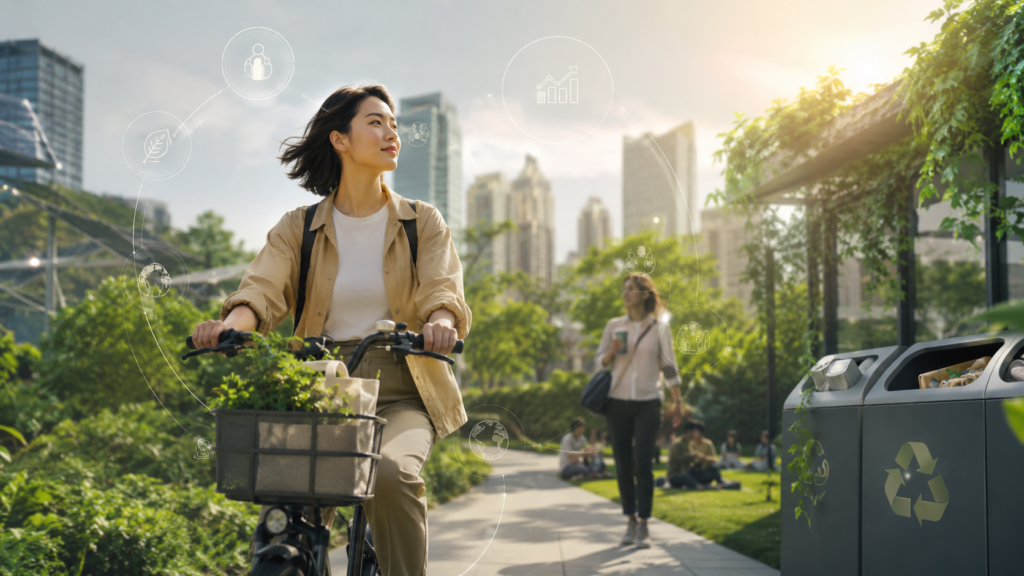
Riding a bicycle to work, using a reusable tumbler, reducing single-use plastics, choosing local products, or participating in zero-waste routines may appear modest on their own. However, when these actions are recorded, measured, and recognized, environmental responsibility becomes something tangible.
A reduced carbon footprint is no longer just a concept. It becomes a personal achievement. It becomes a visible record of contribution.
This shift is important. People are more likely to continue sustainable behavior when they can see the result of their actions. Data, when used correctly, can turn environmental practice into motivation. It allows individuals to feel that they are not merely following a campaign, but actively participating in measurable change.
Healthy Individuals Create Healthier Communities
The social dimension of ESG is also deeply connected to everyday life. A healthier individual can contribute to a healthier community. This may sound simple, but it is one of the most overlooked foundations of sustainability.
Daily exercise, mindful consumption, community participation, and eco-conscious routines do more than improve personal health. They help rebuild a sense of responsibility, connection, and shared purpose.
When people develop consistent routines, they often experience greater self-esteem and stability. When those routines are connected to social value — such as environmental participation, local engagement, or community benefit — individual well-being becomes part of a wider social asset.
This is the true meaning of “life care” within ESG. It is not limited to medical care or wellness services. It includes the systems, habits, and environments that help people live with dignity, responsibility, and connection.
A society does not become sustainable only because companies publish ESG reports. It becomes sustainable when individuals feel empowered to live in ways that support both themselves and others.
Turning Good Practice into a Circular Value System
For ESG to become part of daily life, good behavior must not disappear after a single action. It must return as value.
This is where the idea of circular value becomes essential. When individuals practice careful recycling, reduce waste, or participate in eco-friendly routines, those actions can generate points, rewards, or local benefits. These benefits can then be used for environmentally responsible products, local services, or community-based economic activities.
Such a structure creates a positive cycle.
Sustainable action leads to personal benefit.
Personal benefit encourages responsible consumption.
Responsible consumption strengthens the local and eco-friendly economy.
This is not simply a reward system. It is a new way of connecting personal behavior with economic participation.
A truly sustainable lifestyle must be practical. It must be rewarding enough to continue, simple enough to adopt, and meaningful enough to inspire. When ESG Life Care connects individual action with visible benefits, sustainability becomes less of a burden and more of a lifestyle infrastructure.
ESG Is No Longer Someone Else’s Responsibility
For too long, ESG has been treated as something external — something companies do, something governments regulate, or something investors evaluate. But the future of ESG will require a broader cultural shift.
The ESG index of a society is not measured only by corporate performance. It is also reflected in how people live, consume, care, move, and participate.
Small habits may seem insignificant in isolation. But when they are connected through systems, communities, data, and incentives, they become part of a larger transformation.
That is the promise of ESG Life Care. It brings sustainability closer to the individual. It transforms environmental action into personal achievement, health routines into social value, and responsible practice into economic circulation.
The future of ESG may begin not with a grand announcement, but with a small daily decision.
A reusable cup.
A morning walk.
A carefully sorted recycling bin.
A healthier routine.
A conscious purchase.
These choices may look ordinary. But together, they can raise the ESG index of our lives — and perhaps, over time, the ESG index of the world around us.